

- Home
- Chapter 1 - Object Oriented Programming Concepts
- Object Oriented Programming Concepts
- Multiple Choice Questions
- State whether the given statements are True or False
- Assignment Questions
- Chapter 2 - Introduction to Java
- Introduction to Java
- Multiple Choice Questions
- Assignment Questions
- Chapter 3 - Values and Data Types
- Values and Data Types
- Multiple Choice Questions
- State whether the given statements are True or False
- Assignment Questions
- Chapter 4 - Operators in Java
- Operators in Java
- Multiple Choice Questions
- State whether the given statements are True or False
- Assignment Questions
- Chapter 5 - User-Defined Methods
- User-Defined Methods
- Multiple Choice Questions
- State whether the given statements are True or False
- Assignment Questions
- Chapter 6 - Input in Java
- Input in Java
- Multiple Choice Questions
- Assignment Questions and Programs
- Chapter 7 - Mathematical Library Methods
- Mathematical Library Methods
- Multiple Choice Questions
- Assignment Questions
- Chapter 8 - Conditional Constructs in Java
- Conditional Constructs in Java
- Multiple Choice Questions
- Assignment Questions and Programs
- Chapter 9 - Iterative Constructs in Java
- Iterative Constructs in Java
- Multiple Choice Questions
- State whether the given statements are True or False
- Assignment Questions and Programs
- Chapter 10 - Nested for loops
- Nested for loops
- Assignment Questions and Programs
- Chapter 11 - Constructors
- Constructors
- Multiple Choice Questions
- Assignment Questions and Programs
- Chapter 12 - Library Classes
- Library Classes
- Multiple Choice Questions
- Assignment Questions
- Chapter 13 - Encapsulation and Inheritance
- Library Classes
- Multiple Choice Questions
- Assignment Questions
- Chapter 14 - Arrays
- Library Classes
- Multiple Choice Questions
- Assignment Questions
- Chapter 15 - String Handling
- Library Classes
- Multiple Choice Questions
- Assignment Questions
Conditional Constructs in Java
Chapter 8
Conditional Constructs in Java
Class 10 - Logix Kips ICSE Computer Applications with BlueJ
 Share with a Friend |
Java Program: Compute the perimeter and area of a triangle using Heron’s formula
27. Write a program in Java to compute the perimeter and area of a triangle, with its three sides given as a, b, and c using the following formulas:
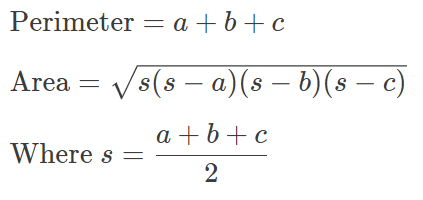
import java.util.Scanner;

public class TrianglePerimeterArea {
    public static void main(String[] args) {
        Scanner sc = new Scanner(System.in);

        double a, b, c;
        double perimeter, s, area;

        System.out.print("Enter side a: ");
        a = sc.nextDouble();

        System.out.print("Enter side b: ");
        b = sc.nextDouble();

        System.out.print("Enter side c: ");
        c = sc.nextDouble();

        // Calculate perimeter
        perimeter = a + b + c;

        // Calculate semi-perimeter
        s = perimeter / 2;

        // Calculate area using Heron's formula
        area = Math.sqrt(s * (s - a) * (s - b) * (s - c));

        System.out.println("\nPerimeter of the triangle = " + perimeter);
        System.out.println("Area of the triangle = " + area);
    }
}
Output
Sample Output
Enter side a: 3
Enter side b: 4
Enter side c: 5

Perimeter of the triangle = 12.0
Area of the triangle = 6.0
✅ Explanation
- The program takes three sides as input using the Scanner class.
- Perimeter is calculated by adding all sides.
- Semi-perimeter (s) is half of the perimeter.
- Area is calculated using Math.sqrt() and Heron’s formula.
- Suitable for school exams, assignments, and practicals.